
Semantic Layer BI Tools: Which Platforms Actually Govern Your Metrics
A comparison of BI tools with native semantic layers, from Omni and Looker to Domo's new 2026 addition. Evaluate which platform actually governs your metrics for AI readiness.
Talk to an expertOn March 25, 2026, Domo announced a semantic layer for its BI platform. That makes Domo the latest in a growing list of vendors rushing to add governed metric definitions to their analytics stack. The timing is not a coincidence. AI agents are entering enterprise workflows, and ungoverned data just became a liability instead of an inconvenience.
The semantic layer is the component that translates raw data into consistent business definitions. Revenue means one thing. Churn means one thing. Every dashboard, every report, and every AI agent uses the same calculation. Without it, you get five answers to the same question depending on which tool you ask.
I was a Looker solution partner when Google acquired them for $2.6 billion. LookML, Looker's semantic modeling language, was the real asset in that deal. I have built semantic layers across fintech, e-commerce, SaaS, and sustainability. This comparison is based on direct implementation experience, not vendor marketing.
Why every BI tool is adding a semantic layer now
The semantic layer is not new. Looker built its entire business on it starting in 2012. What changed is AI. When dashboards were the only consumer of your data, ambiguity was a conversation between humans. Finance saw one revenue number, marketing saw another, and they worked it out in a meeting.
AI agents do not attend meetings. They query data, pick an answer, and act on it. If your revenue metric has three competing definitions across three tables, the agent picks whichever it hits first. No error message. No flag. Just a confident decision on inconsistent data.
This is why Domo, which operated for over a decade without a formal semantic layer, just announced one. Their CTO put it plainly: they are building "a governed agent-building platform, anchored by a semantic layer that keeps business definitions consistent." The market has arrived at the conclusion that governed metrics are not optional for AI.
Gartner estimates 60% of AI projects will be abandoned because the data is not AI-ready. Companies with mature data governance see 24% higher revenue from AI initiatives. The semantic layer is the single fastest path from ungoverned data to AI-ready data.
How semantic layer BI tools compare
Not all semantic layers are built the same. Some platforms were designed around a semantic layer from day one. Others are adding one now to keep up. The depth of the implementation determines whether you get true metric governance or a marketing checkbox.
| Platform | Semantic layer | dbt integration | AI-readiness | Self-service |
|---|---|---|---|---|
| Omni | Native, LookML-compatible modeling layer | Two-way sync | Built for agent consumption | Spreadsheet-style exploration |
| Looker | LookML (the original semantic layer for BI) | One-directional import | Mature but slower to evolve | Explore interface (steeper learning curve) |
| Domo | Data Models + semantic layer (beta, March 2026) | Limited | New agent-building platform | Worksheets (new, spreadsheet-style) |
| Sigma Computing | No native semantic layer | dbt integration available | Limited governance for agents | Strong spreadsheet interface |
| Tableau | No native semantic layer | None native | Tableau Pulse for AI summaries | Drag-and-drop visualization |
| Mode | No native semantic layer | dbt integration available | Limited | SQL notebooks + dashboards |
| dbt Semantic Layer | Standalone metric layer (MetricFlow) | Native (it is dbt) | Designed for downstream consumption | Requires a BI tool on top |
Omni: built on the semantic layer from day one
Omni was founded by former Looker engineers who understood that the semantic layer was Looker's real value, and that it needed to evolve. Omni's modeling layer is LookML-compatible, which means organizations with existing Looker investments can migrate without rebuilding their business logic.
The defining feature is two-way dbt sync. Changes in dbt models automatically reflect in Omni. Changes in Omni's modeling layer can be pushed back to dbt. This eliminates the dual-maintenance problem that every Looker team knows: one version of business logic in LookML, another in dbt, and drift between them over time.
For AI readiness, Omni's architecture is purpose-built. The semantic layer provides governed definitions that AI agents can query through consistent APIs. Every metric is defined once, version-controlled, and accessible to both human dashboards and machine consumers. The self-service layer feels like a spreadsheet, which means finance, marketing, and operations teams answer their own questions without bottlenecking the data team.
In direct migrations we have implemented, organizations saw 50% reduction in BI costs, 80% fewer ad-hoc requests to the data team, and 2x increase in BI adoption.
Looker: the original semantic layer pioneer
Looker invented the semantic layer for BI with LookML. Every dimension, measure, and relationship is defined in code, version-controlled through git, and deployed through a governed workflow. For over a decade, this was the gold standard for metric governance.
Since the Google acquisition in 2020, Looker has been folded into Google Cloud. Development velocity has slowed. The platform remains powerful but increasingly tied to the Google ecosystem. dbt integration exists but is one-directional: you can import dbt documentation, but the modeling layers remain separate.
For organizations deeply embedded in Google Cloud with large existing LookML codebases, Looker still delivers strong governance. For everyone else, the gap between Looker's semantic layer and the newer alternatives is widening. The self-service experience has not kept pace with tools like Omni and Sigma, and business users still depend heavily on the data team for ad-hoc analysis.
Domo: late to the semantic layer, big on agents
Domo operated for over a decade as a full-stack BI platform without a formal semantic layer. Their March 2026 announcement introduces Data Models (in beta) and semantic layer enhancements that allow teams to define relationships between datasets once and reuse them across the platform.
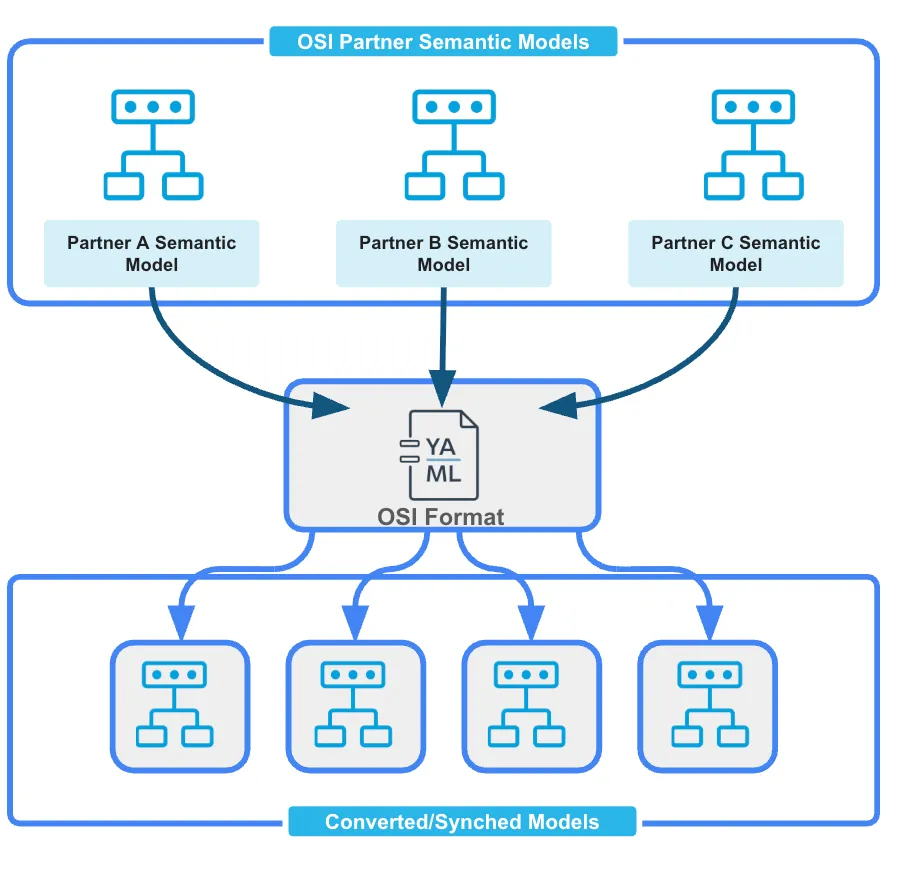
The timing is strategic. Domo is positioning as an "agent-building platform" and has committed to the Open Semantic Interchange (OSI) initiative for semantic interoperability across platforms, including Snowflake. They also launched Worksheets, a spreadsheet-style interface, and Report Builder for PDF.
The question for data teams evaluating Domo is maturity. A semantic layer announced in beta in 2026 is not the same as a semantic layer that has been in production since 2012 (Looker) or one architecturally native from launch (Omni). The governance capabilities, the depth of metric definitions, and the edge cases that surface in enterprise deployments take years to refine. Domo's agent-building ambitions are clear, but the semantic foundation they are building on is brand new.
Sigma, Tableau, and Mode: strong tools, no native semantic layer
Sigma Computing
Sigma has the strongest spreadsheet-like interface in the market. Business users love it because it feels like Excel connected to a warehouse. But Sigma does not have a native semantic layer. Metric definitions live in the BI layer, not in a governed modeling layer. For organizations choosing between Sigma and Omni as a Looker replacement, the trade-off is pure self-service flexibility (Sigma) versus governed self-service with a semantic layer (Omni).
Tableau
Tableau leads in data visualization and has the largest installed base in enterprise BI. But it has no native semantic layer. Business logic lives in calculated fields scattered across workbooks. Tableau Pulse adds AI-powered summaries, but these summaries are only as consistent as the underlying definitions. Organizations moving from Tableau typically do so because they need a single source of truth, and Tableau's architecture does not provide one.
Mode
Mode targets analyst-heavy teams with SQL notebooks alongside dashboards. It integrates with dbt but does not offer its own semantic layer. Mode is strong for ad-hoc SQL exploration. It is less suitable for governed, self-service BI that needs to scale to business users and AI agents beyond the data team.
The dbt Semantic Layer as the universal option
dbt's Semantic Layer (powered by MetricFlow) takes a different approach. Instead of embedding the semantic layer in a BI tool, it defines metrics in the transformation layer and serves them to any downstream consumer: BI tools, AI agents, data apps, APIs.
The advantage is portability. Your metric definitions are not locked to one BI vendor. If you switch from Looker to Omni or from Sigma to Tableau, the dbt Semantic Layer stays consistent. It is the closest thing to a vendor-agnostic semantic layer in the market.
The limitation is that dbt's Semantic Layer requires a BI tool on top for visualization and exploration. It is a metric layer, not a complete analytics platform. For organizations running dbt (which is most modern data teams), it is a natural complement to whatever BI tool they choose. Omni's two-way sync with dbt makes this combination particularly powerful because the semantic layers stay synchronized instead of competing.
How to evaluate a semantic layer BI tool
When comparing semantic layer BI tools for your organization, these are the criteria that matter in practice:
- Governance depth. Can you define metrics once and enforce them across every consumer? Or are definitions suggestions that analysts can override? True governance means one calculation, everywhere, with version control.
- dbt compatibility. If your data team runs dbt (and most modern teams do), how deep is the integration? One-directional imports create drift. Two-way sync eliminates it.
- AI readiness. Can AI agents query the semantic layer directly? Are definitions exposed through APIs that machines can consume? The semantic layer that only serves dashboards is already outdated.
- Self-service adoption. Does the BI layer let business users explore data without involving the data team? A semantic layer that only data engineers understand is governance without adoption.
- Migration path. If you are leaving Looker, can your existing LookML models transfer? Starting from scratch on metric definitions is a 3-to-6 month project. Compatibility cuts that to weeks.
- Provider independence. Is the semantic layer locked to one warehouse or one cloud? Provider-agnostic architecture protects your investment if you need to change any component of your stack.
The pattern: from dashboards to agents
The BI market is going through the same architectural shift that happened in 2018 with data engineering and 2022 with dashboard sprawl.
In 2018, companies hired Data Scientists who spent 80% of their time cleaning data. The problem was not the scientists. It was the missing data foundation.
In 2022, companies built hundreds of dashboards that nobody trusted. Finance and marketing showed the CEO different revenue numbers. The problem was not the dashboards. It was the missing semantic layer.
In 2026, companies are deploying AI agents on data that has no governed definitions. Domo just added a semantic layer. Every BI tool that does not have one is next. The problem is not the agents. It is the missing governance underneath them.
Different era. Same architectural mistake. The companies that build the semantic layer first will be the ones whose AI agents actually work.
How Unwind Data helps you choose and implement
At Unwind Data, we have implemented semantic layers since before the term was mainstream. We were a Looker solution partner during the Google acquisition. We have migrated organizations from Looker to Omni. We have built dbt Semantic Layer implementations from scratch.
We help you evaluate which semantic layer approach fits your organization, implement it on your existing data infrastructure, and connect it to the BI and AI tools your team needs. The result is one source of truth that scales from your first dashboard to your hundredth AI agent.
For every dollar companies spend on AI, six should go to the data architecture underneath it. The semantic layer is where that investment starts compounding.
Deep dives on modern data engineering
Semantic layers, modern stacks, and scalable architecture — in your inbox, not in a backlog.
Unwind Data
Speak with a data expert
We've helped scale-ups and enterprises move faster on exactly this kind of work — without the trial and error. Strategy, architecture, and hands-on delivery.
Schedule a consultation