
Google Officially Separated Looker from Data Studio
Google just reversed the Looker Studio rebrand, reinstating Data Studio for the free tool and keeping Looker exclusively for enterprise governed analytics. For those of us who spent years explaining LookML to confused clients, this is overdue.


For three years, I had the same conversation at the start of almost every enterprise engagement. A stakeholder would Google "Looker," expecting dashboards. They'd find results mixing two very different products. I'd spend the first 30 minutes of a discovery call explaining that what I was building for them had nothing to do with the free tool their marketing team was already using.
That was the cost of Google's brand mistake. And on April 10, 2026, they quietly fixed it.
Looker Studio is being renamed back to Data Studio. The Looker vs Data Studio distinction is now official product strategy, not practitioner tribal knowledge. If you are not a LookML practitioner, this might sound like a minor naming change. It is not.
What Google Actually Announced
Data Studio returns as the home for personal, ad-hoc data exploration. Free, connected to BigQuery, Google Sheets, and Google Ads. Ideal for individual analysis and quick dashboards. It picks up a Pro tier for teams that need more control without the full Looker platform.
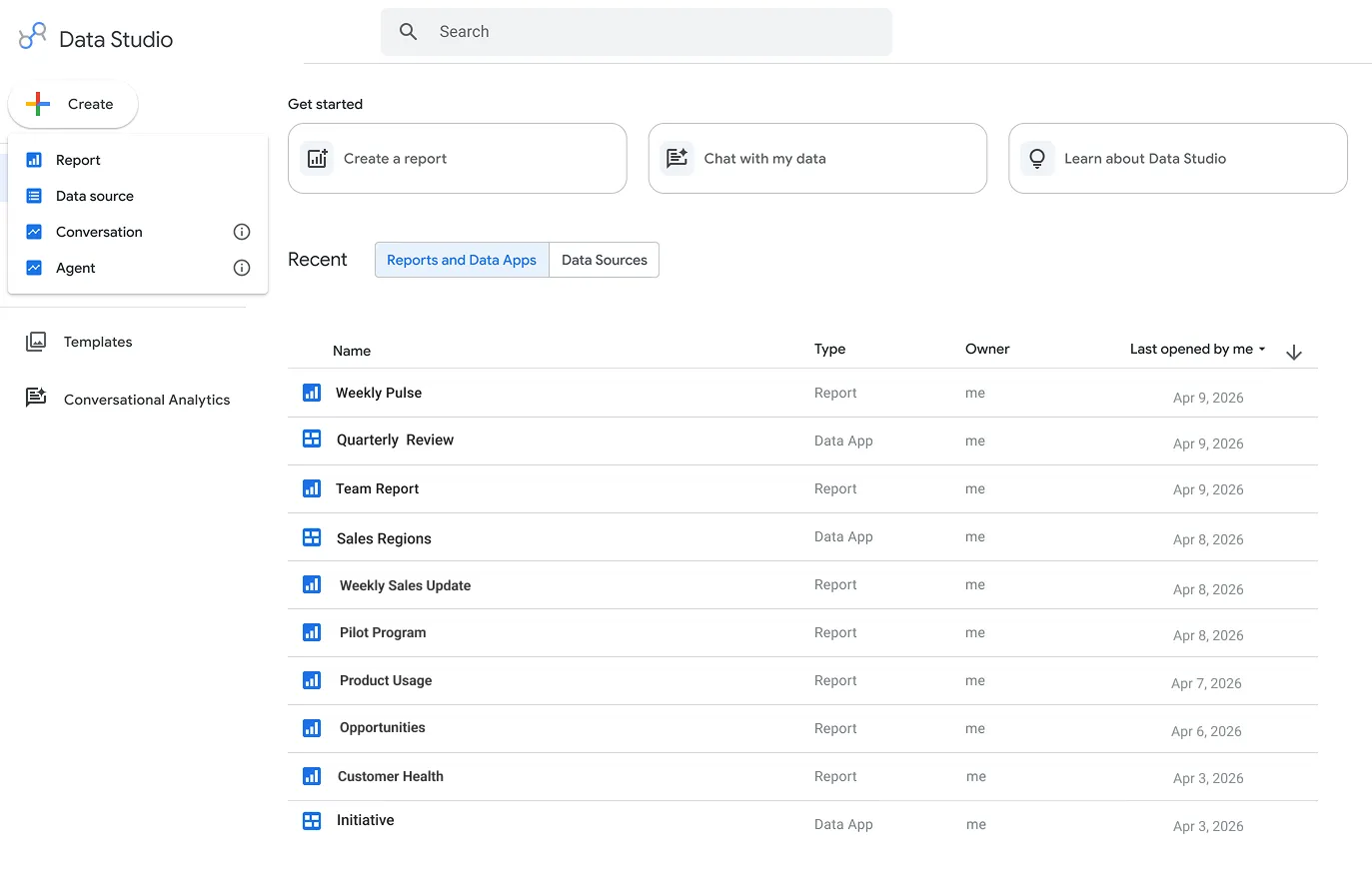
Looker, meanwhile, is explicitly positioned as the enterprise business intelligence platform. The announcement highlights Looker's "agentic capabilities" and frames the product around "trusted, governed data powered by a central semantic model." That language is deliberate. It is not marketing copy. It is a product strategy statement.
Google is drawing a line between two fundamentally different approaches to data. One is exploratory and individual. The other is governed and institutional. They needed different names because they are genuinely different things.
Why the Brand Confusion Happened and What It Cost
Google acquired Looker in 2020 for $2.6 billion. At the time, I was a Looker solution partner. I had spent years implementing LookML for enterprise clients, writing the modeling layer that sits between raw data and the business users who need governed, trusted metrics. LookML is a proprietary semantic layer language. It defines business logic, enforces metric definitions, and ensures that when a finance team and a sales team both ask "what was revenue last quarter," they get the same number.
That is not a dashboarding tool. That is data infrastructure.
When Google renamed its free Data Studio product to "Looker Studio" in 2022, the damage was immediate. Enterprise buyers conflated the two. Procurement teams asked if they could "just use the free Looker Studio instead." Sales cycles got longer because I was explaining brand taxonomy instead of architecture decisions. Professionals who had spent years building credibility around LookML expertise suddenly had to specify "enterprise Looker" to avoid confusion.
The rebrand was a classic product portfolio mistake: using a premium brand name to lift a free product, without understanding that the premium brand's value came from its complexity, exclusivity, and institutional trust.
Why the Separation Matters Right Now
The timing of this reversal is not accidental. It is happening because of agentic AI.
AI agents need data they can trust. Not data they can explore. Not dashboards they can screenshot. They need a governed semantic layer that gives them consistent, context-aware definitions of business concepts. What is "active customer"? What is "monthly recurring revenue"? What counts as a "conversion"? These definitions need to live somewhere authoritative, accessible to AI systems in a structured way.
LookML does exactly this. It is a semantic layer by design. Every metric, every dimension, every join in Looker is defined once and reused everywhere. When you connect an AI agent to a Looker semantic model, the agent does not hallucinate revenue definitions or invent metric logic. It reads the governed definitions and operates within them.
This is why Google is doubling down on Looker's enterprise positioning. The agentic AI era does not need more dashboards. It needs better semantic layers. And the free dashboarding tool had no role to play in that story. Keeping it under the Looker name was actively confusing the market at the moment when clarity matters most.
The Semantic Layer Is the Piece Most AI Projects Skip
In the Intelligence Allocation Stack, the semantic layer is Layer 2. It sits between the data foundation, which handles warehousing, ingestion, and data quality, and the orchestration and AI layers above it. Its job is to translate raw data infrastructure into business logic that machines and humans can both understand.
This is the layer most enterprise AI projects skip entirely. They build the data warehouse. They deploy the AI agent. They skip the semantic layer and wonder why the agent gives inconsistent answers, hallucinates metrics, or requires a human to validate every output before it reaches a decision-maker.
The pattern repeats. In 2018, companies hired Data Engineers to fix raw data access. In 2022, they deployed dashboards to fix reporting. In 2026, they are deploying AI agents on top of unmodeled, ungoverned data and calling it transformation. The semantic layer is the fix that keeps getting skipped.
Google's decision to separate Looker from Data Studio is, in effect, Google acknowledging that the semantic layer deserves its own product category. Looker is not a visualization tool. It is a governed data modeling platform with visualization on top. The free dashboarding tool is the on-ramp. The LookML semantic layer is the destination.
What This Means for Enterprise Data Teams
If you are running a data team at a scale-up or enterprise, this announcement should prompt a specific question: where does your business logic live?
If the answer is "in our dashboards," you have a data governance problem. Dashboard definitions drift. Different teams maintain different versions. When you try to connect an AI agent to that environment, it inherits the inconsistency of every metric definition that was never centralized.
If the answer is "in our semantic layer," you are in a strong position. Whether that semantic layer is built in LookML, dbt MetricFlow, Cube, or another governed alternative, the critical thing is that business logic is defined once, in an authoritative location, accessible to both humans and AI systems.
If the answer is "we do not have one," now is the time to build it. Not because it is theoretically correct, but because AI agents are becoming a real investment and the absence of a semantic layer is the most reliable predictor of AI project failure in the enterprise context. Gartner estimates that 60% of AI projects will be abandoned because data is not AI-ready. The semantic layer is not a luxury item on that checklist. It is the load-bearing wall.
What Changes Practically
For existing Looker Studio users, the transition is low-friction. Google has confirmed that all existing reports, data sources, assets, and users will migrate to the new Data Studio experience automatically. No action required.
The bigger shift is strategic. Google is now explicitly stating that Looker is for enterprise governed analytics and agentic AI use cases, while Data Studio is for personal exploration and ad-hoc reporting. Teams currently using free Looker Studio for anything that resembles governed reporting or metric management should treat this as a product signal: they are using the wrong tool for the job.
Feature investment follows positioning. Looker will continue to receive deeper semantic model capabilities, stronger agentic integrations, and more enterprise data governance features. Data Studio will improve as a personal analytics surface. Expecting one to do the job of the other will become increasingly unrealistic as the roadmaps diverge.
A Note on LookML as a Head Start
LookML remains one of the most misunderstood technologies in the enterprise data stack. Companies that have invested in building a proper LookML model, with governed dimensions, certified metrics, and controlled access patterns, have a significant head start on the agentic AI transition. Their business logic already exists in a machine-readable, governed format. Connecting AI agents to it is an engineering problem, not an architecture problem.
Companies that skipped to dashboards without building the model layer are facing something harder. You can connect an AI agent to a Looker instance with no semantic model, but you will spend the next several months explaining to executives why the agent keeps giving inconsistent answers. The data architecture has to come first. For every dollar companies spend on AI, six should go to the data architecture underneath it.
The Looker rebrand is Google saying the same thing in product strategy terms: the semantic layer is the serious investment. The free dashboarding tool is the entry point.
The Bottom Line
Google spent four years muddying the Looker brand. They are now cleaning it up because the agentic AI era demands precision about what "governed data" actually means. The confusion was costly for practitioners for years. Now it is costly for Google's product positioning too.
The separation of Looker and Data Studio validates what LookML practitioners have argued for a long time: the modeling layer is not a feature of a dashboarding tool. It is a distinct data infrastructure discipline that determines whether AI can be trusted to operate on your business data.
If you are evaluating your data strategy for AI readiness, the question is not which dashboarding tool you use. The question is whether your business logic is governed, defined, and accessible to the AI systems you are building. That is what Looker is for. And now, finally, that distinction is official.
Deep dives on modern data engineering
Semantic layers, modern stacks, and scalable architecture — in your inbox, not in a backlog.

More from Unwind Data
Apache Ossie: The Rename Is Not the Story
OSI is now Apache Ossie (Incubating). The rename is cosmetic. The governance transfer to the Apache Software Foundation is the story — and what it signals for the semantic layer as infrastructure.
Semantic Layer Consulting & Data Architecture in Amsterdam
Unwind Data is an Amsterdam-based data consultancy specialising in semantic layer implementation and data architecture for scale-ups and enterprises building AI. Independent, vendor-neutral, and practitioner-led.
AtScale vs dbt Semantic Layer: Enterprise vs Engineering-First
AtScale and dbt Semantic Layer both promise a single source of truth for metrics. But they represent two completely different architectural philosophies and serve two different organizational realities. Here is the head-to-head comparison that vendor demos will not give you.
Ready to unlock your data potential?
Let's talk about how we can transform your data into actionable insights.
Get in touch